Projektowanie, programowanie …
Na schemacie widoczny jest fragment diagramu blokowego pewnego algorytmu. Ile razy zostanie zweryfikowany warunek n<7?
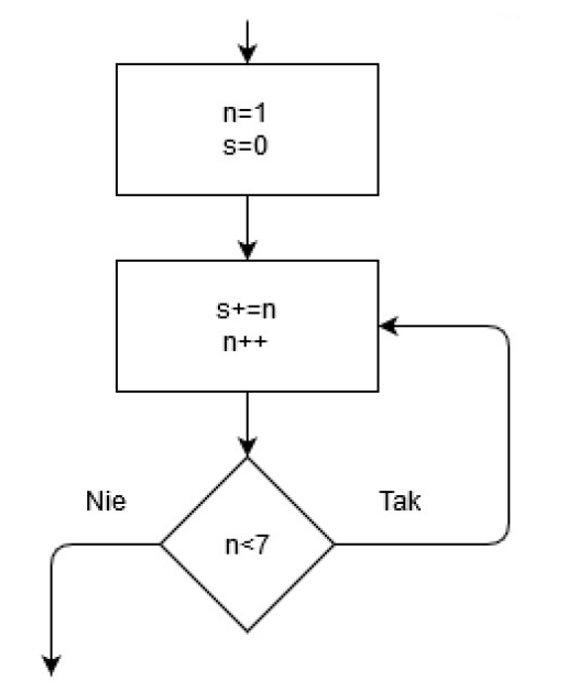
A. 6
B. 7
C. 5
D. 8
List<int> wykaz = new List<int>();
pierwiastki = {"N": "Azot", "O": "Tlen", "P": "Fosfor", "Si": "Siarka"}
class Animal {
  constructor(name) {
    this.name = name;
  }
  speak() {
    return `${this.name} makes a noise.`;
  }
}

class Dog extends Animal {
  speak() {
    return `${this.name} barks.`;
  }
}

let dog = new Dog('Rex');
console.log(dog.speak());
interface IMyInterface {
    private: int a;
    IMyInterface() { a = 0; }
    void mth1();
}
Definicja 1 | interface IMyInterface { private: int a; void mth1(); int mth2() { return a; } } Definicja 2 |
interface IMyInterface {
    void mth1();
    int mth2() { return 0; }
}
Definicja 3 | interface IMyInterface { void mth1(); int mth2(); } Definicja 4 |
tags: string[] = ['tag1', 'tag2', 'tag3' ];
// ...
<p *ngFor="let tag of tags"> {{tag}} </p>
KOD W REACT.JS:
state = {   tags: ['tag1', 'tag2', 'tag3']   };
// ...   /* w instrukcji return metody render */
<React.Fragment>
  { this.state.tags.map(tag => <p key={tag}>{tag}</p>) }
</React.Fragment>
for (let number = 2; number <= 20; number++) {
    let check = true;
    for (let test = 2; test < number; test++) {
        if (number % test === 0) {
            check = false;
            break;
        }
    }
    if (check) console.log(number);
}
var random = new Random();
string pulaZnakow = "abcdefghijklmnopqrstuwxyzABCDEFGHIJKLMNOPQRSTUWXYZ0123456789";

int dlPuli = pulaZnakow.Length - 1;
char znak;
string wynik = "";

for(int i = 0; i < 8; i++)  {
    znak = pulaZnakow[random.Next(0, dlPuli)];
    wynik += znak;
}
<ComboBox SelectionChanged="Funkcja1" DragEnter="Funkcja2"
    LostFocus="Funkcja3" KeyDown="Funkcja4">
</ComboBox>
W kodzie:
private void Funkcja1(object sender, SelectionChangedEventArgs e)
{
    MessageBox.Show("Zdarzenie 1");
}
private void Funkcja2(object sender, DragEventArgs e)
{
    MessageBox.Show("Zdarzenie 2");
}
private void Funkcja3(object sender, RoutedEventArgs e)
{
    MessageBox.Show("Zdarzenie 3");
}
private void Funkcja4(object sender, KeyEventArgs e)
{
    MessageBox.Show("Zdarzenie 4");
}